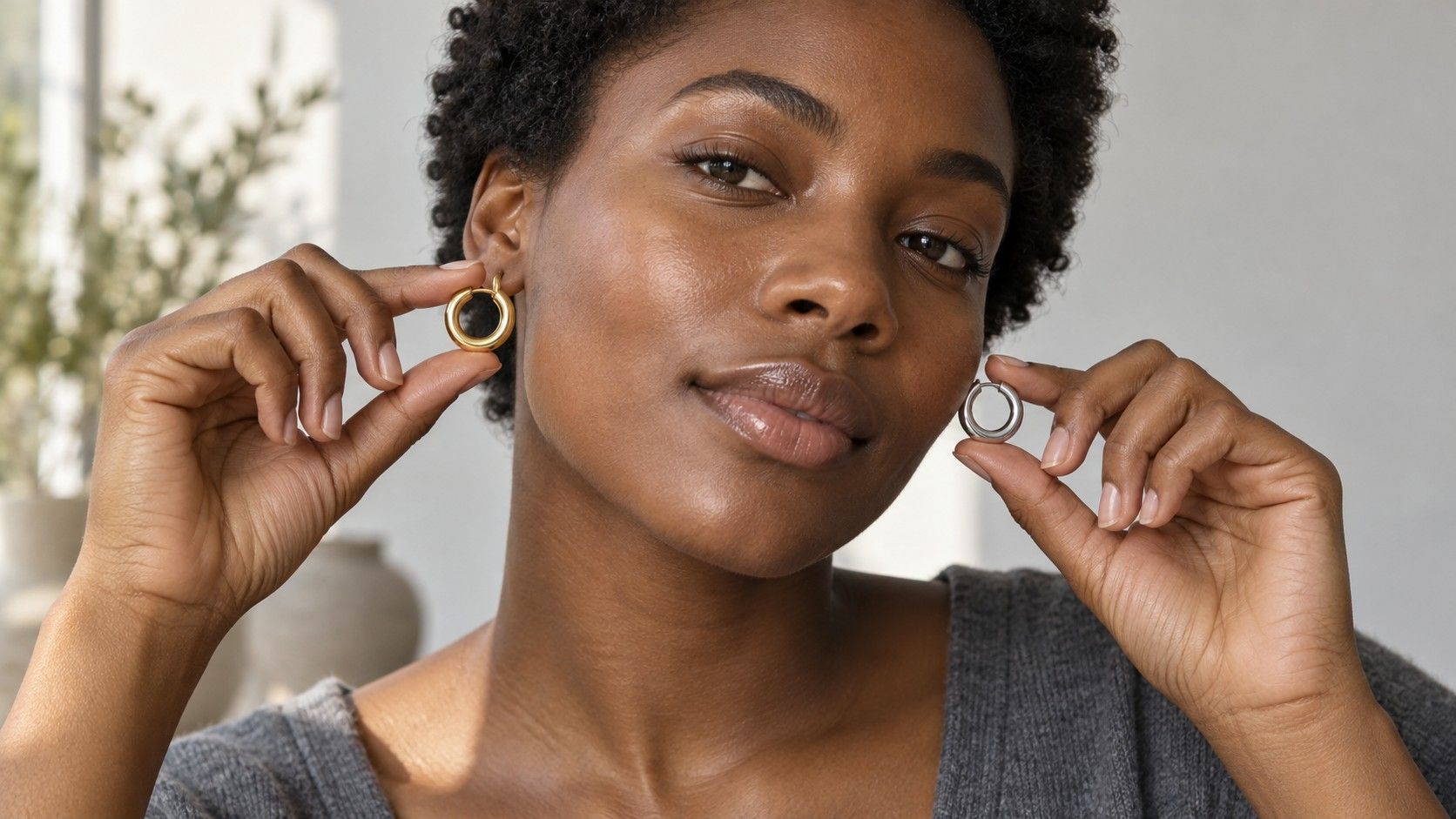
A gold or silver test works best as a simple jewelry comparison. Match the pieces, use soft daylight and watch the effect near your face before treating a preference as evidence about your undertone.
Make the two pieces comparable before looking at your skin
A large polished gold hoop and a tiny brushed silver stud make a poor comparison. Size, shine and shape change the effect before metal color enters the picture. Choose two pieces with a similar visible area and finish, ideally earrings of comparable size or two simple chains. Borrowing a suitable piece for a few minutes can be more useful than buying something specifically for a test.
Look closely at the actual shades. Yellow gold, pale champagne gold and rose gold do not create the same impression. Silver-colored jewelry can look bright white, softly gray or darkened, depending on its finish and condition. For a first comparison, use a straightforward yellow-gold color and a straightforward silver color. You can explore variations once you know which difference you are responding to.
If you have only one suitable piece in each color, hold them in turn near the same cheek or collarbone. Keep their distance from your face consistent. A mirror comparison of earrings is more relevant to earrings than holding a ring against the wrist. There is no need to identify the exact alloy for a visual trial, though material suitability for sensitive skin is a separate purchasing decision that appearance cannot settle.
Set up soft daylight and take off competing colors
Use a window with indirect daylight and switch off nearby warm or cool lamps. Direct sun creates sharp highlights on metal, while a yellow bathroom bulb can make both the jewelry and the face look warmer. Stand where you can see the whole face comfortably, rather than moving close enough to inspect individual pores. A plain gray or another quiet neutral top makes the comparison easier to read.
Move a bright scarf away from the neckline and avoid standing beside a strongly colored curtain. Reflected color can influence what you see on the lower face. If you are wearing makeup, decide what question you want to answer. For everyday jewelry worn with your usual makeup, test that combination. For a more general comparison, try again on another day with minimal makeup, rather than assuming foundation color is your natural coloring.
Try gold, then silver, then reverse the order. Look at each for a moment without staring until every small shadow seems meaningful. A change in cloud cover is a reason to pause and repeat both pieces under the new light. You do not need identical laboratory conditions, but the metal should be the main thing that changes. Keep the mirror position and your head angle reasonably steady.
Watch the face, then decide which effect you actually want
The gold or silver skin tone test is often reduced to a verdict about warm or cool undertone. That asks more of a jewelry comparison than it can reliably provide. A preference may reflect the shade of the metal, its brightness, your hair, your outfit or familiarity with a favorite piece. Use the trial to observe an effect before trying to explain it with an undertone label.
First look at the whole face. Does one piece create a clear frame you like? Does the other blend more gently with the surrounding colors? Then look at the eye and mouth area. If the jewelry attracts your attention first, decide whether that is desirable for the occasion. A statement earring is allowed to be a statement. Blending quietly is another valid aim, not the universal definition of flattering.
| What you notice | A useful follow-up | What it cannot prove |
|---|---|---|
| One metal looks much brighter | Compare pieces with a similar polish and size | That your undertone must belong to a particular category |
| Gold feels softer near the face | Try a paler gold and the same neutral top | That every yellow-gold piece will suit every outfit |
| Silver gives a crisp outline | Check a brushed silver finish as well | That high shine is required for you |
| Both look good in different ways | Choose according to outfit, scale and preference | That you need to force a single winner |
Avoid using vein color as a tie-breaker. How veins appear through skin and under changing light does not turn this styling exercise into a dependable undertone diagnosis. Skin depth and ethnicity are not shortcuts either. If the mirror gives you no clear preference, keep that result. An honest “both work” is more useful than a confident category obtained from an unrelated rule.
Use a photograph to remember a comparison, not certify it
A gold or silver test photo is useful as a record when you cannot wear both pieces at once. Put the camera in one position, keep the framing steady and take the pictures close together in time. Turn off beauty filters and avoid portrait lighting effects. Include the whole face and enough neckline to show the jewelry in context; a tight crop of a small patch of skin answers a narrower question.
Check the images for obvious exposure shifts before comparing them. If your face looks noticeably lighter in one frame, the phone may have adjusted to the reflective metal or a change in framing. A white top can influence exposure too. Retake the pair if necessary, and compare the original files on the same screen. A screenshot sent through an app may look different from the image you saw in the camera gallery.
Automatic white balance, screen settings and image processing can all change apparent warmth. A digital gold overlay placed on an existing selfie introduces its own chosen shade and brightness, so it is best treated as a styling sketch. If an app declares a precise undertone from that image, ask whether the recommendation still looks useful in the mirror with real jewelry. The photograph should support your observation rather than overrule it.
When both metals work, test finish and scale instead
You may discover that the color difference matters less than the surface. A softly brushed gold necklace and brushed silver necklace might both feel comfortable, while either metal in a mirror polish feels too conspicuous. That points to a preference for a gentler reflection. Try the finish you like in both colors before interpreting the result as uncertainty about your skin.
Scale can have an equally large effect. A narrow chain leaves much of the neckline visible; a broad collar forms a substantial new color area. Small studs and long drop earrings frame the face differently even when their metal matches. Repeat a comparison at the size you are considering buying. An easy result with tiny earrings does not predict how you will feel about a large polished cuff worn with a sleeveless top.
Mixed metals are another practical option. A piece that contains both tones can connect a silver watch with a gold ring, but matching every item is a personal styling choice. Start with one repeated detail if a mix feels scattered: two small silver elements beside one larger gold element, for example. Look at the full outfit from a normal conversational distance. Close-up images can exaggerate tiny mismatches that barely register in use.
Turn a tentative preference into a useful buying decision
Before purchasing jewelry, repeat the gold or silver test with an outfit you actually wear. A dark navy collar, a pale knit and a patterned dress create different backgrounds for the same necklace. Hair worn down may surround the earrings; hair tied back makes them more exposed. Check the combination most relevant to the piece instead of collecting more tests in unrelated conditions.
If one color wins consistently, write down the specific version: “pale gold, small brushed earrings” is actionable. “Warm undertone” leaves many unanswered choices about size, shine and shade. When the result changes with clothing, keep two useful pairings. You can prefer silver beside a crisp shirt and gold beside a softer knit without needing to reconcile them into a rule about your whole appearance.
Comfort, fastening, weight and how often you will wear the piece still belong in the decision. A color preference cannot compensate for an earring that feels heavy or a chain that catches on a favorite neckline. Where possible, check a return policy and view the item in ordinary light before committing. Do not buy a collection just to satisfy a result from a quiz.
Stop when you have enough evidence for the choice in front of you. If differences remain slight after a couple of calm comparisons, choose the piece you enjoy wearing. Jewelry changes an outfit through color, shape, reflection and personal meaning together. The useful outcome is a clearer preference you can act on, with room to change your mind when the outfit or occasion changes.