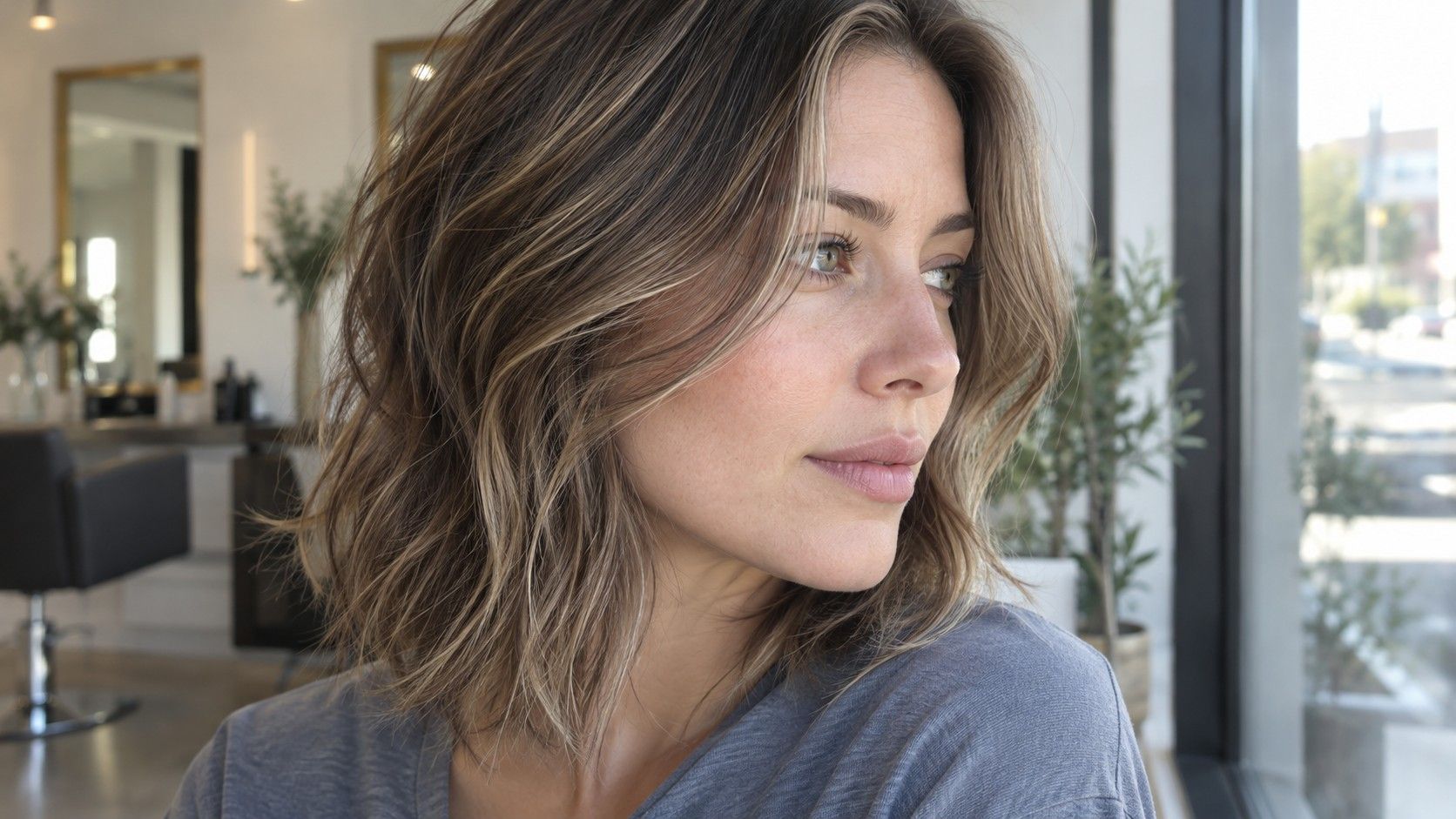
Cool Summer hair color ideas are most useful when you compare tone, depth and placement separately. Start with the hair you have, then use ash and beige references to explain a realistic change.
Look past old color before choosing a new direction
A cool summer hair color search often starts with an ash-blonde photograph, but the useful first reference is the hair you have now. Look at the roots, middle lengths and ends separately in indirect daylight. An older color may have faded differently across those areas. A warmer-looking end does not establish that your natural coloring is warm, and a freshly toned root does not establish that you belong to a cool season.
Take one photograph with your hair down and another with it drawn away from your face. Wear a quiet neutral top and keep the camera and light in the same position. Notice what the existing color contributes: perhaps the darker roots define the face, while the lighter lengths look airy. You may want to keep that relationship and change only the tone. Writing down what already works prevents a seasonal label from turning into an unnecessary full transformation.
In common seasonal systems, the cool summer color palette emphasizes coolness within a relatively gentle range of colors. Different systems draw their boundaries differently. Treat the label as a starting hypothesis for visual comparisons, rather than proof that every warm reflection must disappear from your hair. If your result came from a filtered selfie, repeat a simple clothing comparison in daylight before using it to justify a permanent color change.
Compare ash and beige at a similar depth
Ash and beige are shade descriptions, not identical colors across every salon or brand. One ash sample may look softly gray-brown; another may lean much more smoky. Beige may describe a balanced blonde or one with a noticeable golden cast. Compare physical swatches or clear reference photographs at similar lightness before deciding which word to request. Otherwise, a preference for a darker example can be mistaken for a preference for its undertone.
Hold suitable swatches near the face in ordinary light if they are available at a consultation. Look at the whole combination of hair, skin, brows and eyes. Does the cooler sample give the frame you want, or does it appear heavier than expected? Does the beige option soften the transition, or introduce more yellow than you enjoy? These are preference questions. They do not require you to describe your skin as healthier or less healthy in one color.
| Reference direction | What to compare | Useful question for a colorist |
|---|---|---|
| Ash brunette | Cooler reflection with enough brown depth | Can this effect be achieved from my current color without a large depth change? |
| Soft ash blonde | Lightness as well as the smoky tone | Which part of this image is realistic for my starting point? |
| Neutral beige | A less distinctly gray or golden result | Can we compare this with ash at the same apparent depth? |
| Natural color with small changes | The current root and frame around the face | Could placement or a restrained tonal change meet the goal? |
Keep one reference you like and one you do not, then name the difference precisely. “This is too yellow for my taste” communicates more than “that is not Summer.” The same applies to a sample that feels too gray. A colorist can discuss a visible direction; a seasonal term alone does not describe your starting hair, its history or the amount of change involved.
Keep the depth that gives your face a useful frame
Cool summer hair colors do not have to be pale. The darker area around the roots may provide definition you enjoy, even when the lengths are lighter. To test that, look at your hair against a pale top and then a medium-value one. If the hair appears dramatically different, the background is part of the effect. Keep the outfit steady when comparing two hair references so the apparent contrast is not doing all the persuading.
Distinguish tone from value. Tone describes the color direction people often call cool, neutral or warm; value is how light or dark the hair appears. A dark ash brunette can create more contrast around the face than a beige dark blonde. If your goal is a softer frame, changing the coolness without addressing depth may miss the point. Equally, making everything lighter can remove a boundary you liked around your features.
Ask about retaining depth near the roots or underneath the outer layers when a light reference seems appealing but too uniform. The right placement depends on your haircut, usual parting and the way you wear your hair. Show it tied back as well as loose. A pale section that looks subtle when the hair is down can sit prominently beside the face in a ponytail. Those daily views deserve a place in the decision.
Read digital try-ons as sketches of a possible change
A try-on image can help separate the ideas “lighter” and “cooler” before a consultation. Start with a clear, unfiltered photograph in even daylight. Compare a few restrained versions, keeping the face and background unchanged. If the tool alters skin color, makeup or eye brightness at the same time, it becomes difficult to know whether you prefer the hair or the extra image changes.
Pay attention to the hairline, parting and ends. A digital overlay can apply an even color across areas that would behave differently in a real service. It may also erase highlights and shadows, making a shade look like a flat painted surface. Use the result to explain a direction, such as “less golden but similar depth,” rather than asking a professional to reproduce a screen pixel exactly.
Save the original photograph beside the edit. View both at a normal size and on the same screen, with any warm display mode switched off if you can do that easily. Even then, screens and cameras do not provide a reliable salon color specification. A realistic appointment discussion still needs your existing color history and an in-person assessment of what your hair can support.
Bring a clear comparison and a realistic maintenance limit
At a consultation, explain your current hair before presenting the desired result. Mention previous color services, home coloring and any uncertainty about what was used. Bring photographs that show the same preferred direction on more than one person, ideally in ordinary light as well as a polished studio image. A single photograph may owe much of its appeal to lighting, styling and editing.
Describe your maintenance limit in practical terms. Say whether you want visible roots to blend softly, whether frequent appointments fit your routine and whether you normally use heat styling. Ask what the color is likely to look like as it changes between visits. An image of freshly finished hair cannot show the entire period you will live with the result. There is no universal appointment interval that follows from a seasonal category.
Follow the product manufacturer's instructions and your professional's directions for any coloring or maintenance product, including the checks specified for that product. Do not select processing details from a seasonal chart or improvise combinations to chase an ash label. The visual aim and the technical service are separate discussions; the latter depends on the actual hair, product and color history.
Choose the smallest change that answers your question
If you like your natural depth but dislike a warm cast in photographs, begin by checking whether that cast appears in the mirror under neutral daylight. Warm indoor lamps and a phone's white balance can be convincing. When the concern exists mainly in one lighting setup, changing the hair may not solve it. Compare more than one ordinary setting before committing to a new direction.
If you still want a change, define one priority: cooler reflection, gentler highlights or less contrast at the roots, for example. Ask a colorist what a restrained first step would look like for your starting point. Changing depth, tone and placement all at once makes it harder to understand which part you enjoy. A smaller adjustment can give you information without requiring a complete new identity or wardrobe.
The best reference is the combination you want to wear repeatedly. Check the proposed direction with the clothes, glasses and makeup you normally use. Cool summer is a vocabulary for exploring color relationships, not a requirement to become uniformly ashy. Keep enough flexibility to choose a balanced beige, a cooler brunette or your natural color when that gives you the result you prefer.